

AVAILABLE TRUCKS vs. QUALIFIED TRUCKS
For years, when the transportation industry talked about truck capacity, the conversation was pretty simple:
How many trucks are available?
I think that question is becoming outdated.
The better question today is:
How many qualified trucks are actually available to haul your freight?
And if you don't work in transportation every day, here's what I mean by qualified.
A truck simply being available doesn't mean it should be hauling your freight.
The driver needs to be properly licensed and qualified. The truck and trailer need to meet safety requirements. The trucking company needs to be legitimate, properly insured and operating within federal and state regulations.
And right now, government regulators are increasingly going after drivers, trucking companies and training operations that don't meet those standards.
The numbers are getting our attention.
🚨 THE GOVERNMENT IS REMOVING QUESTIONABLE CAPACITY
Recent Federal Motor Carrier Safety Administration (FMCSA) enforcement efforts have targeted fraudulent operations, improperly issued commercial driver's licenses (CDLs), questionable driver-training programs, unsafe equipment and higher-risk trucking companies.
According to information presented by FMCSA Administrator Derek Barrs and discussed in DAT's August 31 market update:
More than 30,000 improperly issued CDLs have been revoked.
Approximately 10,000 fraudulent CDL training schools have been shut down.
Roughly 3,200 drivers have been placed out of service for English-language proficiency deficiencies.
Of 704 higher-risk trucking companies selected for audits, 430 - about 61% - voluntarily ceased operations after being notified that an investigation was coming.
Then there is Operation Highway Shield.
DAT reported that a recent enforcement wave across Illinois, Indiana, Iowa and Ohio included approximately 3,500 stops. It resulted in 766 drivers and vehicles being placed out of service, along with arrests, immigration-related detentions and approximately $1 million in stolen freight being recovered.
Those aren't simply regulatory statistics.
They're freight-capacity statistics.
Every driver, trucking company or piece of equipment removed from service can potentially reduce the number of qualified trucks available to haul freight.
And this isn't happening in isolation.
Colorado, Idaho and Michigan recently joined a growing list of states that have stopped issuing non-domiciled commercial driver's licenses or commercial learner permits.
In plain English, these are special commercial licenses that can be issued to certain drivers who are legally in the United States but aren't permanently domiciled here.
A nationwide audit previously found that more than 30 states had issued licenses or permits that FMCSA determined did not comply with federal requirements.
That does not mean every driver holding a non-domiciled CDL is unqualified. Properly issued licenses can remain valid, and qualified drivers continue operating.
The bigger point is this:
The standards surrounding who can legally enter and remain in the commercial driver pool are tightening.
🚛 BUT GOVERNMENT ENFORCEMENT ISN'T THE WHOLE STORY
This distinction is important.
The trucking industry entered the current freight cycle with too many trucks competing for too little freight.
That created an extremely difficult environment for trucking companies.
When too many trucks compete for the same shipments, carriers lower their prices to win the work. Eventually those prices can become too low for some companies to cover fuel, insurance, maintenance, equipment payments and driver costs.
Over several years, that gradually pushed some small trucking companies and independent owner-operators out of the market.
DC Velocity recently summarized the freight recovery this way:
The recovery is being driven less by a dramatic increase in freight and more by fewer trucks competing for the freight that's already moving.
TD Cowen's Jason Seidl similarly described the prolonged trucking downturn as largely a supply problem - there were simply too many trucks - and said that capacity is still leaving the market.
FTR's Avery Vise adds an important qualification: government enforcement is contributing to the disruption, but economics drove much of the reduction in truck capacity in the first place.
So there are really two things happening at the same time:
Economics removed excess capacity.
Government enforcement is now putting additional pressure on the remaining pool of qualified capacity.
And we're beginning to see the results.
📊 THE NUMBERS ARE TELLING THE SAME STORY
This week we looked at market information from Triumph, DAT and Truckstop/FTR.
These companies measure the freight market differently, which is exactly why we like comparing them.
When several independent sources begin pointing in the same direction, we pay attention.
TRIUMPH - AUGUST 31
Triumph's National Full Truckload Freight Index declined 2.9% last week and 3.1% over the past month.
For someone outside transportation, think of this index as a way of measuring what is happening with truckload pricing across the country.
A 2.9% weekly decline sounds like the freight market is getting weaker.
Until you zoom out.
The same index remains 35.8% higher than it was at this time last year.
Here is the breakdown by the three major types of truckload equipment:
Article content
Rates down. Year-over-year strength remains.
So yes, freight rates have cooled from their summer highs.
But they remain dramatically higher than they were one year ago.
The market is cooling from elevated levels - not returning to last year's market.
That's an important difference.
📈 THEN SOMETHING CHANGED
Truckstop/FTR's latest spot-market data showed an interesting change last week:
Available loads: +11.2%
Available trucks: -2.2%
Overall market pressure: +13.7%
A load is simply a shipment that needs a truck.
So in plain English:
More freight became available at the same time fewer trucks were available to move it.
Total spot-load activity was also nearly 23% higher than the comparable week last year.
The spot market is the part of trucking where shipments are priced individually rather than moved under longer-term contracted rates. Because it reacts quickly when trucks become easier or harder to find, it can provide an early indication of changing market conditions.
After eight consecutive weeks of declining broker-posted spot rates, the national market finally stopped falling and ticked slightly higher.
Dry van loads jumped 14.5% for the week.
Refrigerated loads increased 11.9%.
Even flatbed loads increased 9.7% after six consecutive weekly declines.
One week doesn't make a trend.
Labor Day timing could also be affecting some of these numbers.
But when the number of shipments increases at the same time the number of available trucks decreases:
We pay attention.
🔎 DAT SEES IT TOO
DAT's latest market information tells essentially the same story.
Truckload rates across the major equipment types remain roughly one-third above last year's levels, even though overall freight demand hasn't exploded.
DAT's Dean Croke specifically pointed to higher year-over-year rates against relatively flat to modestly higher demand as evidence that fewer trucks are competing for approximately the same amount of freight.
That's important because it helps explain something that might otherwise seem contradictory:
If America isn't experiencing a freight boom, why are truckload rates still so much higher than last year?
Increasingly, the answer appears to be on the truck-supply side of the equation.
FTR says trucks have been gradually leaving the market for roughly three years, but only within approximately the past six months has the available supply of trucks fallen below what is needed to comfortably handle freight demand.
FTR described the current environment particularly well:
“It’s really a slight volume increase on top of extraordinarily tight capacity.”
Translated into everyday language:
Freight doesn't have to increase very much when there aren't many extra trucks sitting around waiting for it.
That may be the most important takeaway in this week's report.
🏭 MEANWHILE, WHERE FREIGHT COMES FROM IS CHANGING
There's another trend we've been watching closely.
For years, discussions about freight demand have focused heavily on the American consumer.
How much are people buying?
How strong are retail sales?
Are people buying houses, furniture, appliances and cars?
Those things still matter.
But increasingly, we're seeing another source of freight demand developing:
Companies building things.
Billions of dollars are being committed to:
AI data centers
Semiconductor manufacturing
Power infrastructure
Advanced manufacturing
Aerospace and defense
Distribution and fulfillment centers
Large industrial projects
We've collected several examples just this week.
SpaceX is developing massive industrial projects in Texas and Louisiana.
Lam Research broke ground on a new semiconductor research facility in Oregon as part of a larger investment aimed at advanced AI chips.
Walmart announced a $1.3 billion, 1.5-million-square-foot automated fulfillment center in Georgia.
Rolls-Royce completed a $1 billion manufacturing investment in Indiana supporting aircraft-engine production for U.S. military programs.
And the latest U.S. trade data gave us another clue.
Capital-goods imports posted their largest monthly increase since 1993, including computers, semiconductors and telecommunications equipment.
Why does that matter to trucking?
Because factories, data centers and large industrial projects require enormous amounts of material and equipment.
Steel has to move.
Electrical equipment has to move.
Machinery has to move.
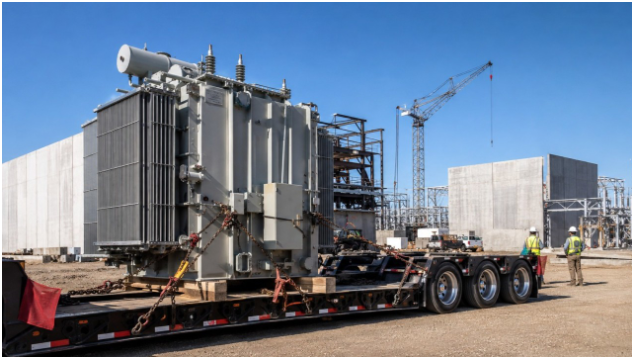
Generators and transformers have to move.
Construction materials have to move.
Eventually, finished products have to move.
Not all freight demand comes from consumers buying more stuff.
Increasingly, companies building things could become an important source of freight demand.
And there is one distinction we watch closely:
Announcements tell us where freight might be headed.
Groundbreakings tell us when freight may actually start moving.
🚚 NEW TRUCKS AND TRAILERS ARE BEING ORDERED - BUT THERE'S A CATCH
Trucking companies are also beginning to invest in equipment again.
July orders for Class 8 trucks - the large tractors you see pulling most highway semi-trailers - reached 22,100 units, up 68% from last year.
That marked the eighth consecutive month with a year-over-year increase.
Trailer orders are improving too.
July trailer orders totaled 16,862 units, up 22% from June and 23% above the 10-year average for July.
Year-to-date trailer orders are running 25% ahead of last year.
At first glance, that might sound like trucking companies are preparing to put thousands of additional trucks and trailers on the highway.
Not necessarily.
FTR says trailer demand remains more replacement-driven than expansion-driven.
That's an important distinction.
The nation's trucking equipment has aged during the prolonged freight downturn. Eventually, companies have to replace older tractors and trailers simply to maintain their existing fleets.
Think of a company replacing ten old trucks with ten new trucks.
It bought ten trucks.
But it didn't add ten trucks to the freight market.
It still has ten.
Equipment orders don't automatically mean more truck capacity.
Sometimes companies are simply replacing what they already have.
⛽ FUEL WATCH
We received the latest U.S. diesel number this morning.
National on-highway diesel averaged:
$5.599 per gallon
That's down 5.3 cents from last week, following the previous week's sharp increase.
So carriers finally received a little relief at the pump.
But once again, we need to zoom out.
Diesel remains:
$1.865 per gallon higher than one year ago.
That's a substantial increase in one of the trucking industry's largest operating expenses.
And there's another reason we're continuing to watch fuel closely.
U.S. inventories of diesel and similar fuels recently fell to 103.4 million barrels, a record seasonal low in the data we've reviewed.
Those inventories are essentially America's available cushion of diesel-type fuels.
A smaller cushion doesn't guarantee prices will rise.
But it means there may be less room to absorb a disruption just as we approach a period when global demand for these fuels typically increases because of fall agriculture and, later, winter heating needs.
So this week's 5.3-cent decline is certainly welcome.
It doesn't necessarily eliminate the fuel risk heading into fall.
🔭 WHAT HAPPENS NEXT?
We're not predicting that freight rates are suddenly about to explode.
That's important.
DAT's current 35-day outlook points toward a relatively stable market through September and into early October.
The summer spike has cooled.
But underneath that short-term stability, something has changed.
There is less extra truck capacity sitting on the sidelines.
And that means relatively small changes in freight demand can potentially have a larger effect than they did when trucks were plentiful.
Here's a very simple example:
100 shipments chasing 120 qualified trucks
There are more trucks than shipments.
The customer has leverage.
Now imagine:
105 shipments chasing 100 qualified trucks
Freight increased only 5%.
But suddenly there aren't enough trucks for every shipment.
The truck has leverage.
That's why the number of qualified trucks matters so much.
Freight demand doesn't necessarily have to explode.
The balance between freight and trucks simply has to change.
🚛 COACH LOGISTICS TAKE
For the past several years, finding a truck wasn't particularly difficult.
There were simply too many trucks chasing too little freight.
That market is changing.
Some truck capacity disappeared because carriers couldn't survive several years of poor economics.
Now increased government enforcement is putting additional pressure on the remaining pool by targeting fraudulent credentials, unsafe operations, questionable training programs and trucking companies that aren't meeting regulatory standards.
At the same time, we're beginning to see signs of improving freight activity — particularly from manufacturing, infrastructure and large industrial investment.
Put those pieces together and I believe the most important question for shippers is changing.
It used to be:
“How many trucks are available?”
Today, I think it's:
“How many qualified trucks are actually available?”
And there's a big difference between the two.
For anyone responsible for shipping freight, this is also why carrier selection matters.
A low price is important.
But so is knowing who is actually hauling your freight.
Are they properly licensed?
Are they properly insured?
Is the equipment safe?
Is the trucking company legitimate?
Does the carrier have a good safety history?
Those questions become even more important as questionable capacity is removed from the marketplace.
The cheapest truck isn't necessarily the least expensive truck if it's a truck you shouldn't have hired in the first place.
And the freight market doesn't necessarily need a massive economic boom to tighten from here.
It may simply need:
A little more freight.
A few fewer trucks.
And fewer of those trucks actually qualifying to haul it.
That's the market we're watching.
THE FREIGHT SIGNAL - BY COACH LOGISTICS
Connecting the dots behind the freight market - and explaining what they mean for the people who ship freight every day.
Sources: DAT iQ / DAT Freight & Analytics • Truckstop/FTR Transportation Intelligence • Triumph Market Insights • Federal Motor Carrier Safety Administration • Transport Topics • DC Velocity • U.S. Energy Information Administration • U.S. Census Bureau • Manufacturing Dive • Supply Chain Dive • ACT Research/FTR



Comments